
ESD Packaging 101: Pink Poly vs. Shielding Bags

Updated: Jan 4
Author: Johnson Chong, CEO

CEO of Adsure Packaging Limited
Master's degree from the University of Warwick
30+ years of expertise in producing automated packaging bags
Helps operations teams choose consumables that match their bagging equipment.
Proven strategies to cut material waste, reduce downtime, and drive cost-effective efficiency across your packaging line.
【Length: 1,150 words | Estimated reading time: 5–6 min】
ESD damage is one of the most expensive “invisible failures” in electronics fulfillment and light assembly. Choosing the wrong bag can pass incoming inspection, yet still increase returns, field failures, and warranty claims weeks later. This guide explains the practical differences between pink anti‑static bags and true shielding bags—plus how to select ESD materials that run reliably on automated bagging lines.
TL;DR – Key Takeaways
Pink poly mainly reduces static generation on the bag surface; it is not designed to block external ESD events.
Shielding bags are used when components need protection from electrostatic discharge during handling and transport.
On auto‑baggers, ESD performance must be paired with runnability: stable opening, consistent COF/slip, clean perforations, and reliable sealing.
The best outcome is “no ESD incidents + no line disruption,” which requires a short qualification run at realistic speeds before rollout.
When choosing ESD packaging for your electronics, understanding the difference between Pink Poly vs Shielding Bags is critical for preventing costly static damage.
Why ESD packaging decisions hit Ops & Procurement
What Ops feels (not “static”)
For operations, the pain rarely shows up as “static.” It appears as:
Random test failures or intermittent defects.
Higher return rates on small electronics accessories.
Extra touches: rebagging, adding inserts, additional labeling and handling steps.
What Procurement gets blamed for later
For procurement, the challenge is that ESD bags are often treated like a commodity SKU—until a failure forces emergency requalification, expedite freight, and production interruptions. ESD packaging is best handled as a risk‑managed specification, not a lowest‑bid line item.
Pink poly: what it is (and what it is not)
What pink anti‑static poly is good for:
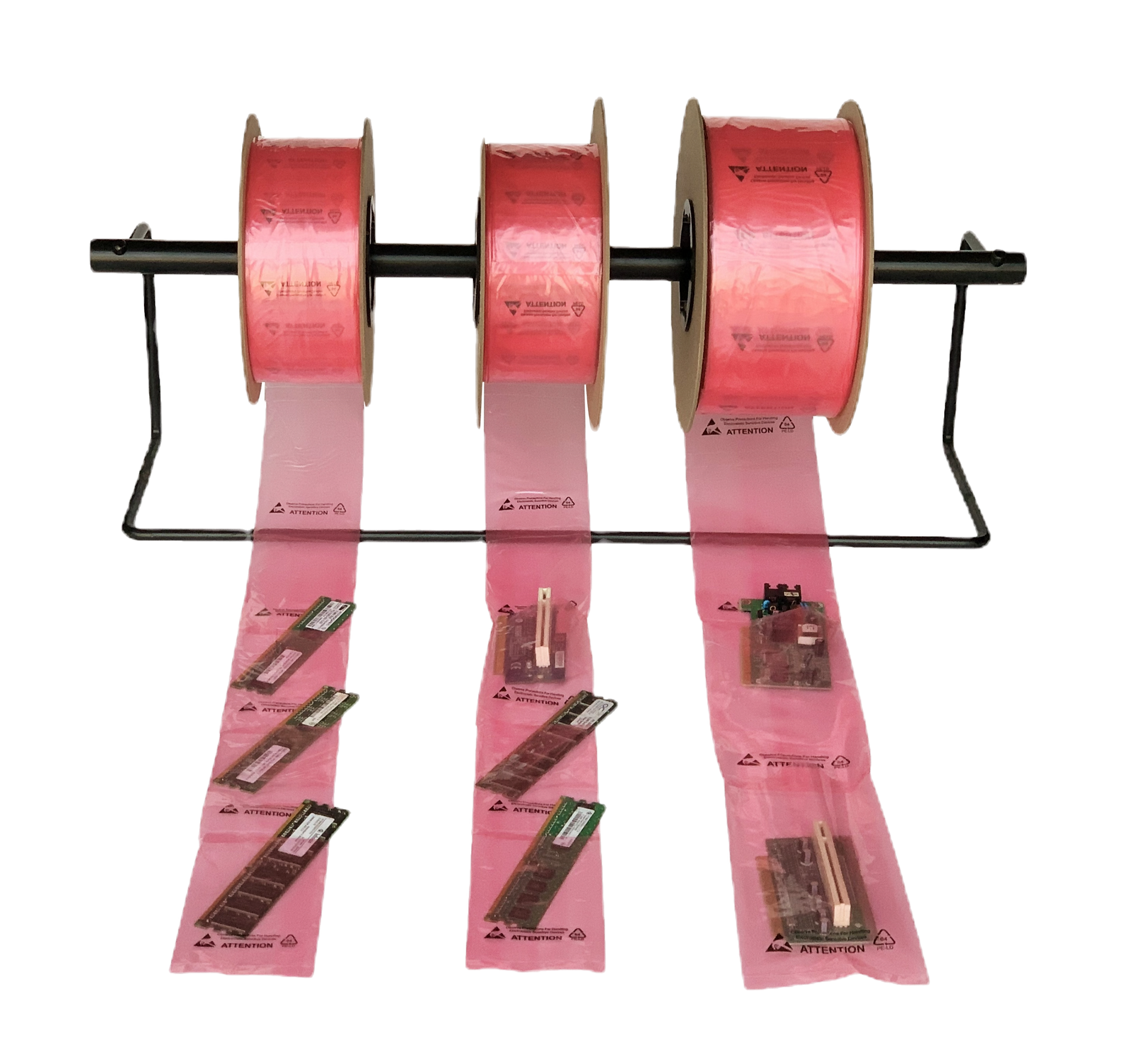
Pink poly is commonly used when the goal is to reduce static build‑up caused by friction (for example, bags sliding on conveyors, operators handling bags quickly, or bags rubbing against products). In many operations, this is enough to prevent nuisance static and reduce attraction of dust and debris.
What pink poly is not designed to do:
Pink poly is not a “shield.” If an external discharge event occurs, pink anti‑static material is not intended to provide discharge shielding like a metallized shielding structure would. This distinction is a common cause of “it looked fine, but failures increased later.”
Explain it to non‑engineers (simple)
Pink poly helps reduce the bag becoming a “static generator.”
Shielding helps protect the product when the outside world delivers a discharge event (Faraday‑cage effect in shielding structures).
Shielding bags: when they are the right choice
Shielding bags are typically used for higher sensitivity components (PCBs, ICs, modules) where ESD events can cause immediate or latent damage during handling, transport, and storage. Industry guidance tied to ANSI/ESD S541 emphasizes that discharge shielding is required in less controlled environments (outside the EPA/ESD Protected Area), which is exactly where many shipments and cross‑dock movements live.
Procurement alignment (risk profile)
Use the bag type that matches the risk, not the lowest unit price:
If product sensitivity is low and handling is well controlled end‑to‑end, pink anti‑static may be sufficient.
If sensitivity is high or the item moves through uncontrolled handling/transport, move up to shielding solutions.

Pink anti-static bags (left) help reduce static build-up from friction during handling, while metallized shielding bags (right) provide discharge shielding for ESD-sensitive components in higher-risk or less controlled environments.
What changes when you run ESD bags on auto‑baggers
On an automated bagging line, ESD bag selection cannot ignore runnability. Even the “excellent” ESD material fails if it causes jams, poor seals, or inconsistent opening at speed.
Key operational fit points:
Opening reliability: Bags must open consistently at the loading station without curling or sticking.
COF / slip behavior: Too “grabby” can cause feeding issues; too “slippery” can cause control issues depending on the machine’s drive design.
Perforation quality: Unstable tear behavior creates tension spikes and misfeeds.
Seal window: Some ESD structures need adjusted sealing parameters; poor match shows up as weak seals or burn‑through.
If your site already optimized settings for standard PE bags, expect a short tuning window when moving to ESD formats—especially shielding structures. (more layers/complexity).
A practical selection matrix (Pink Poly vs Shielding Bags)
Decide fast with 3 questions
1.How sensitive is the product?
Low sensitivity accessories → start with pink anti‑static.
PCBs / modules / ICs → evaluate shielding as default.
2.How controlled is the environment?
Controlled ESD workstations end‑to‑end → lighter protection may work.
Mixed handling, third‑party transport, cross‑dock → higher protection.
3.What is your biggest cost driver today?
Returns/field failures → don’t under‑spec the bag.
Line downtime/jams → prioritize runnability specs and supplier validation.
Qualification plan: reduce risk before rollout
A short qualification run prevents the two classic failures:
“ESD bag solved the risk, but the line keeps jamming.”
“Line runs great, but ESD incidents continue.”
Recommended 3 steps:
Step 1 — Bench check (paperwork + samples)
Confirm bag size, thickness, sealing guidance, and any ESD compliance claims with documentation. If your process prints barcodes/labels, confirm print surface compatibility and ribbon match.
Step 2 — Low‑speed trial on one line (stability first)
Log opening issues, seal appearance, print quality (if applicable), and jam count.
Step 3 — Full‑speed A/B test (prove “cost per good pack”)
Compare jams per shift, scrap, and rework against your baseline bag. Use the same operator, settings, and SKUs where possible; only change the bag.
What to put in the purchase spec (so it’s enforceable)
To keep ESD bags from becoming “whatever arrived this week,” write a spec procurement can enforce and suppliers can consistently hit:
Checklist 3 — Purchase Spec Items (Make It Enforceable)
Bag type by SKU family: Define which SKUs use pink anti-static vs shielding (and where each is allowed to be used).
Location rule (EPA vs outside EPA): For ESDS items transported outside an EPA, require packaging with discharge shielding (align with ANSI/ESD S541 expectations).
Thickness (gauge) + allowable variation: Specify target thickness range and tolerance to avoid runnability drift.
COF / slip requirement: Define a COF/slip range if you have it; otherwise specify a functional requirement (must feed/open consistently at target speed without instability).
Perforation consistency requirement: Must not cause indexing tension spikes, misfeeds, or premature tearing on your machine.
Seal performance requirement: No seal failures at target speed under defined sealing settings (and document the settings used in the trial).
Print surface (if applicable): Must support your thermal transfer / print-and-apply process without incomplete transfer or barcode scan failures.
Lot traceability + labeling: Require manufacturer identification and date/lot code traceability on packaging/COA where applicable (traceability is referenced in ANSI/ESD S541 guidance).
Change notification policy: Supplier must notify and obtain approval before any resin/additive, structure, thickness, COF/slip, perforation, or process change.
Trial requirement + acceptance metrics: Sample → low-speed → full-speed A/B, with required KPI reporting (e.g., jams/10k, micro-stops/shift, scrap/rework, bags per paid hour) before awarding volume.
The goal isn’t just “ESD safe.” It’s “ESD safe at full throughput.” When pink anti‑static is enough, it keeps cost low and lines fast. When shielding is required, qualifying the right structure—and validating runnability—prevents expensive invisible failures without creating visible downtime.


Comments